Jordan Zakery is a Legislative Director for ExcelinEd in Action.


As Arkansas continues to strengthen education policy across the state, one question remains central: What do Arkansans want from their schools?
ExcelinEd collaborated with UpOne Insights and Impact Partners to gain a better understanding of Arkansans’ views on key education issues.
The survey of 400 registered Arkansas voters, conducted online from Sept. 22 – Oct. 1, 2025 (±5.59%), illustrates strong support for policies that focus on academic rigor, school accountability, high-quality instruction and real-world preparation. The data suggest that voters are aligned around a concept of education that focuses on student outcomes.
Below are some of the most important insights from the survey—and what they reveal about the future of education in the Natural State.
When asked about the direction of K–12 education in Arkansas, voters are optimistic. Forty-six percent say the direction of K-12 education in the state is moving in the right direction while 34% believe it is on the wrong track. Views are somewhat more positive when voters consider their local schools, with 52% saying local education is moving in the right direction, compared with 31% who say it is on the wrong track.
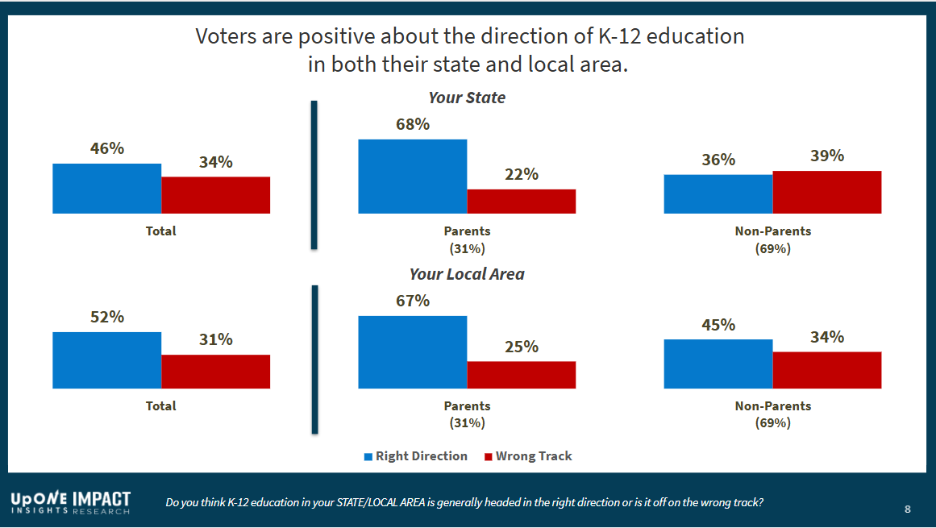
Survey responses suggest there is more confidence in local education as well as an expectation for continued improvement.
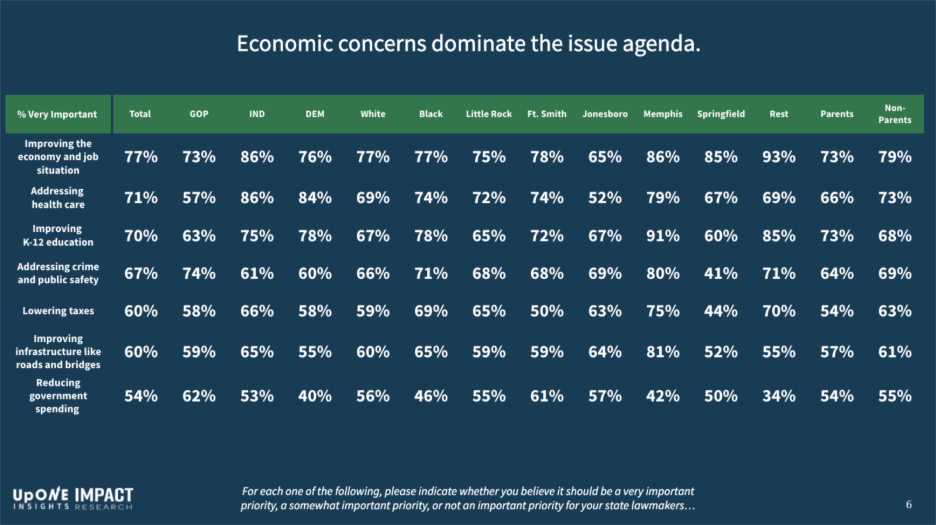
Seventy percent of Arkansas voters say K-12 education is a “very important” priority for state leaders, placing it on par with healthcare. A high level of importance placed on strong schools demonstrate education as foundational to Arkansas’ economic growth, workforce readiness and overall quality of life into the future.
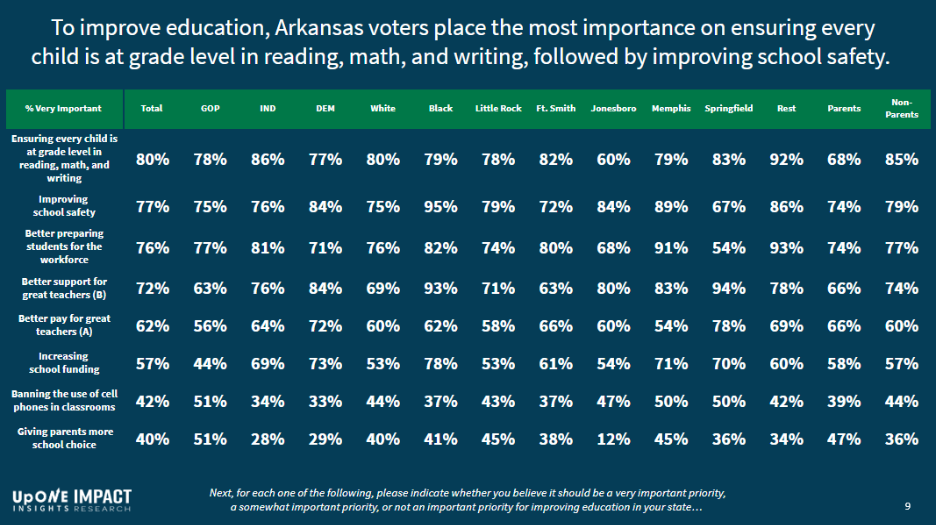
When asked what matters most in education, Arkansans spoke clearly: students must master the basics.
An overwhelming 80% say grade-level proficiency in reading, writing and math is “very important.” Academic fundamentals are a top priority for surveyed voters in the state.
By a wide margin, public sentiment in Arkansas underscores the importance of our focus on foundational skills, including literacy across both early childhood and into adolescence. Strengthening these fundamentals of reading, writing and math is central to improving long-term student outcomes.
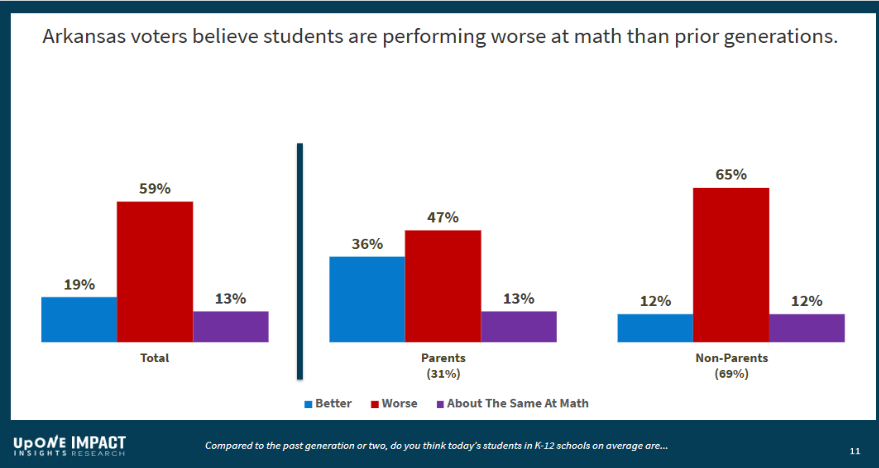
Few issues in education generate as much consensus in Arkansas as the need to improve math outcomes.
Most Arkansans—59%—believe students today are worse at math than previous generations, signaling a statewide concern about how well schools are equipping students with the skills necessary for success.
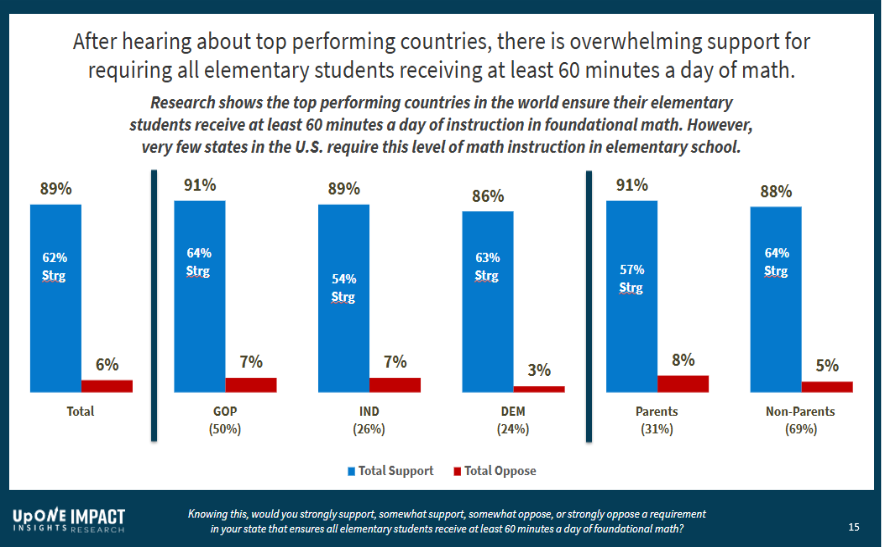
Improving math scores starts with guaranteeing at least 60 minutes of daily math instruction. Regular, sustained practice builds the foundation students need to succeed, and this standard mirrors the approach of top-performing countries. When asked about a proposal to introduce 60 minutes of daily math instruction, survey respondents voiced an overwhelming level of support (89%).
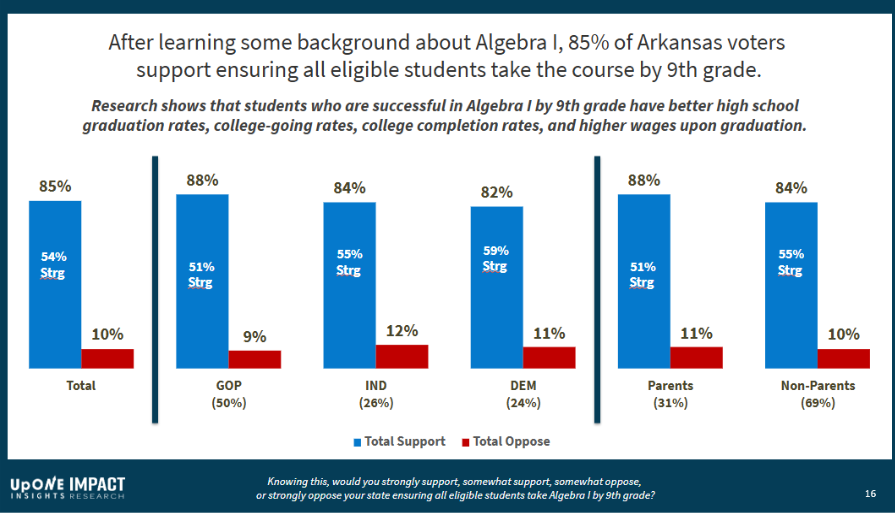
A substantial body of research links success in Algebra I to improved academic and career outcomes. As a result, ExcelinEd’s comprehensive math policy includes requiring all students to take and pass Algebra I or Integrated Math I (IM I) by ninth grade. This policy also received strong support among Arkansans (85%).
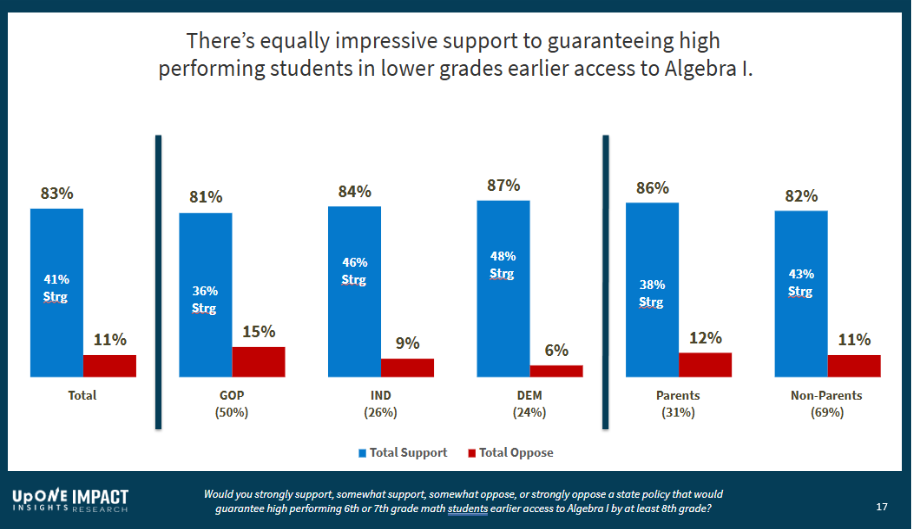
Guaranteed access to advanced math is another proven math policy that has been adopted in a number of states. It ensures that students who are mathematically ready are proactively identified and enrolled in advanced math pathways leading to Algebra I in middle school, positioning high performers to reach higher-level math courses in high school. Support for guaranteed access is also very strong with 83% of respondents strongly in favor.
This strong consensus suggests that Arkansas leaders have significant public backing to continue prioritizing math achievement in the state, as well as a clear opportunity to act. To support that work, ExcelinEd’s Math Matters digital playbook provides policymakers with insight into how the state is performing across 11 research-backed principles that are vital to improving student outcomes.
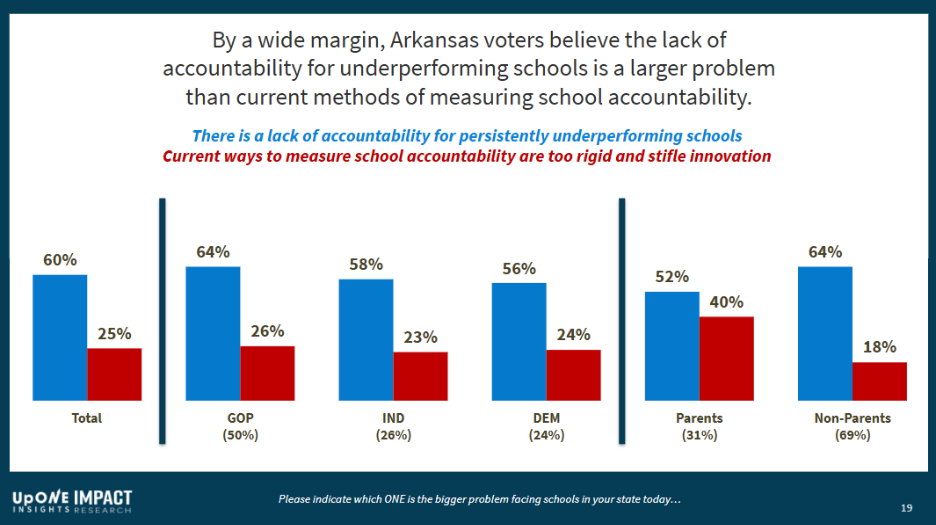
Arkansans value transparency and accountability when it comes to school performance. The most cited concern about schools is a lack of accountability, named by 60% of respondents, not how schools are held accountable.
Arkansas has moved to strengthen and modernize its longstanding A–F school grading approach through the Arkansas ACCESS Act in 2025. The law updated the state’s accountability system and directed the development of a redesigned formula for district- and school-level grades.
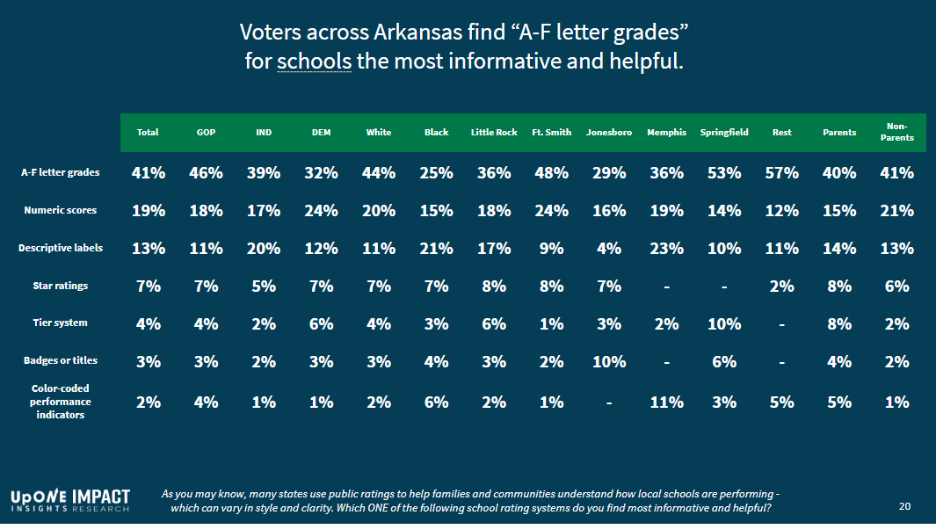
When asked how school performance should be communicated, 41% prefer an A-F letter grade system, compared to the second most popular response of numeric scores, coming in at 19%. This makes it clear that A-F is the most informative and helpful method.
When asked to assess school quality, Arkansas voters say the answer is simple: look at student performance (43%) and academic growth over time (29%). They believe students’ academic outcomes offer the most reliable picture of a school’s performance.
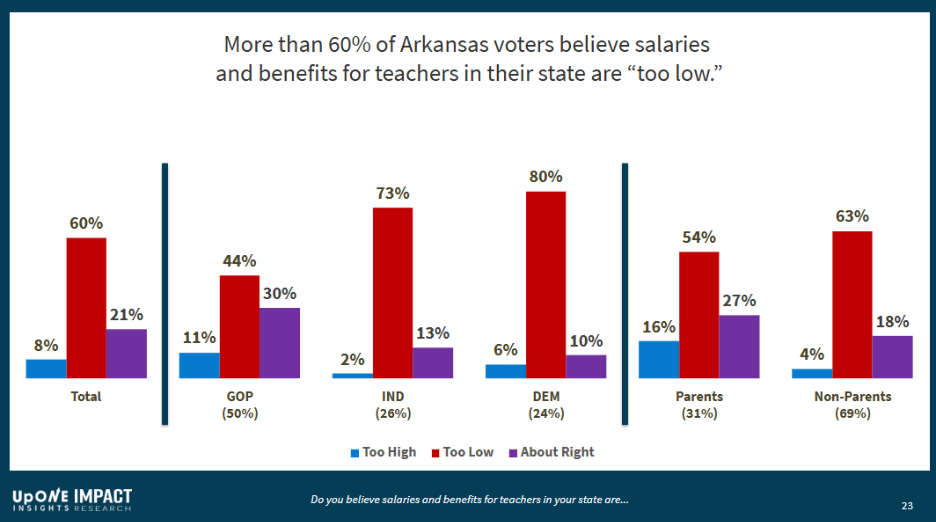
Public support in Arkansas is strong and practical, with most survey respondents saying teacher pay is too low.
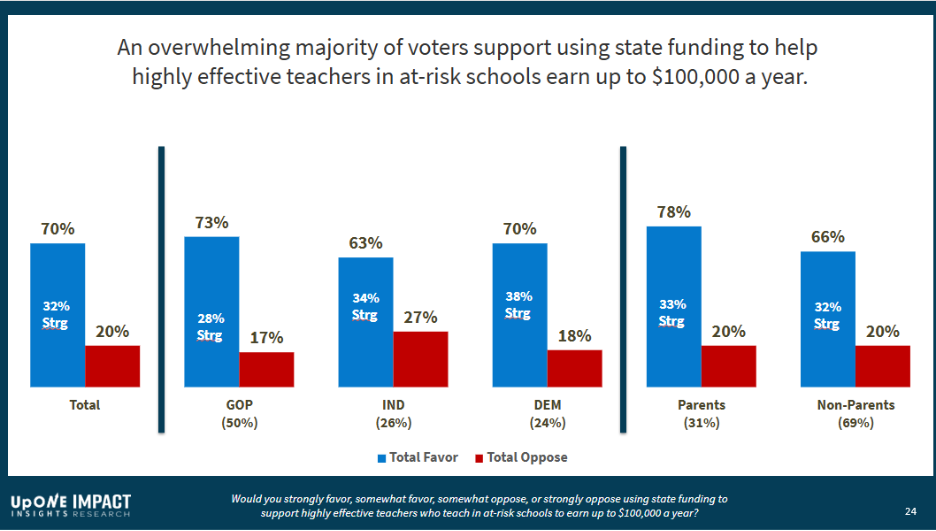
Eighty-three percent of voters support extra pay for highly effective teachers who work in at-risk schools. Arkansans are in favor of resources and incentives aligning with student outcomes and improved performance. Public opinion is ready for teacher policies that attract top talent and encourage high-quality instruction where it matters most.
Arkansans understand the need for solutions that advance the teaching profession, to include improved teacher preparation and competitive compensation.
Over the past few years, Arkansas has significantly expanded its school choice options, most notably through the creation and rapid growth of the Education Freedom Account (EFA) program. Enacted as part of the LEARNS Act in 2023 and fully available to all students statewide for the 2025-26 school year, the EFA program provides families with up to 90 percent of a student’s state education funding to use toward private school tuition, homeschooling costs and other approved educational expenses.
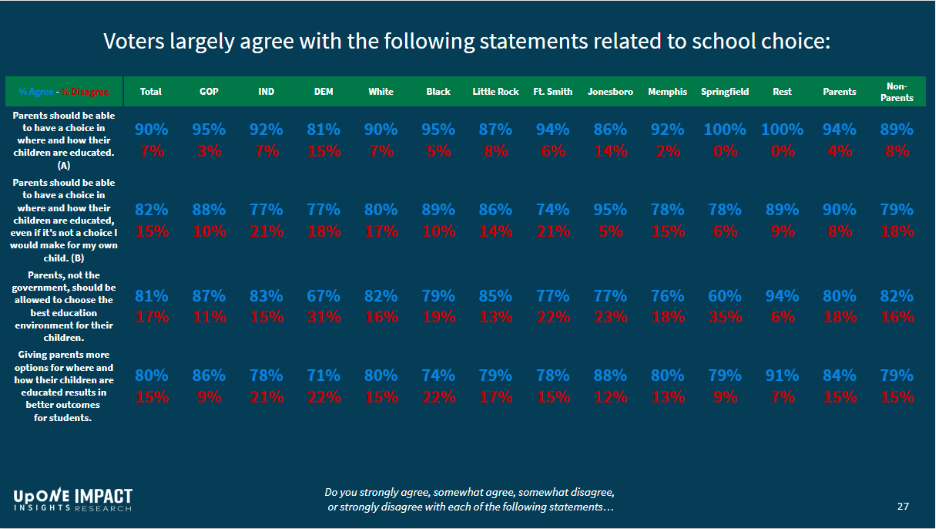
90% of Arkansas voters support parents having a say in how their own children are educated. Importantly, that support largely holds even when those educational choices differ from the respondents’ own views, with 82% agreeing parents should still have that freedom.
When it comes to education funding, Arkansas voters tend to express slightly more concern that schools are underfunded than that existing dollars are being wasted or spent inefficiently.
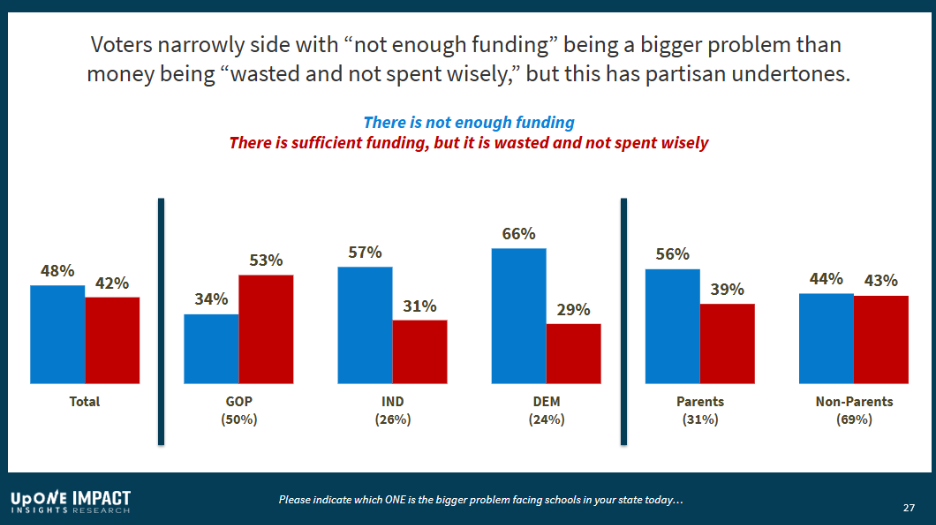
Additionally, respondents agree that more funding should go to schools that serve students with greater learning needs, and that funds should generally follow the student.
Arkansas voters expressed cautious confidence in how well students are being prepared for life after high school. While a narrow majority believe graduates are generally ready to take next steps, opinions become divided when voters consider specific paths. Many are uncertain whether students are equipped for the academic rigors of college, and fewer are convinced that graduates possess the practical, real-world skills needed to succeed in the workforce.
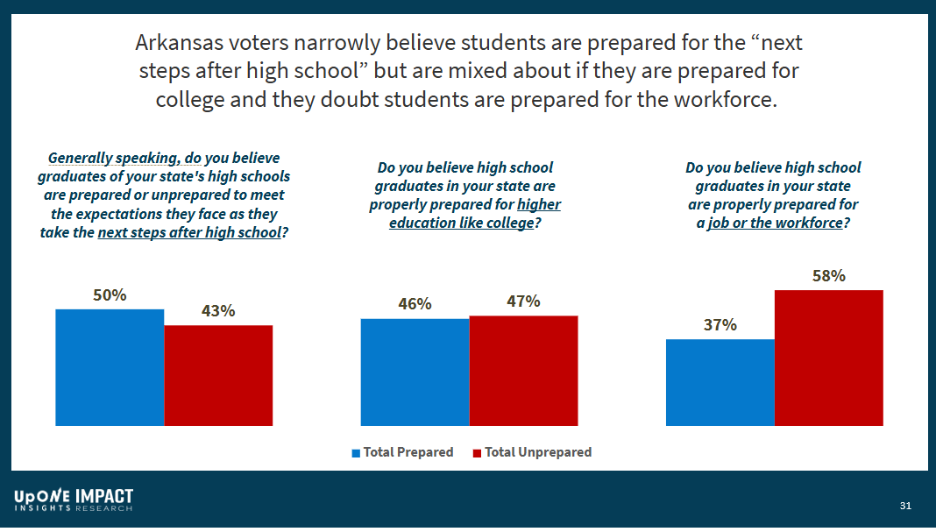
A strong majority of Arkansas voters support the idea of offering financial incentives to schools that successfully guide students into productive postsecondary pathways—whether that means enrolling in college, starting a career or enlisting in the military. Voters may view these incentives as a way to hold schools accountable for tangible outcomes and to encourage a more practical focus on preparing students for real-world success. These findings point to growing public support for aligning education policy with real-world results—whether students pursue college, careers or technical training.
Through our Pathways Matter digital playbook and targeted policy recommendations, ExcelinEd highlights ways to align Arkansas’s K–12 and postsecondary systems with workforce needs, expand access to high-quality credential opportunities and support smooth transitions for students after graduation.
As classrooms become increasingly digitally connected, Arkansans are expressing concern about how technology is being used. Specifically, the ubiquity of cell phones poses a concern for voters. Nearly two-thirds of respondents support making K-12 schools in Arkansas cell phone -free.
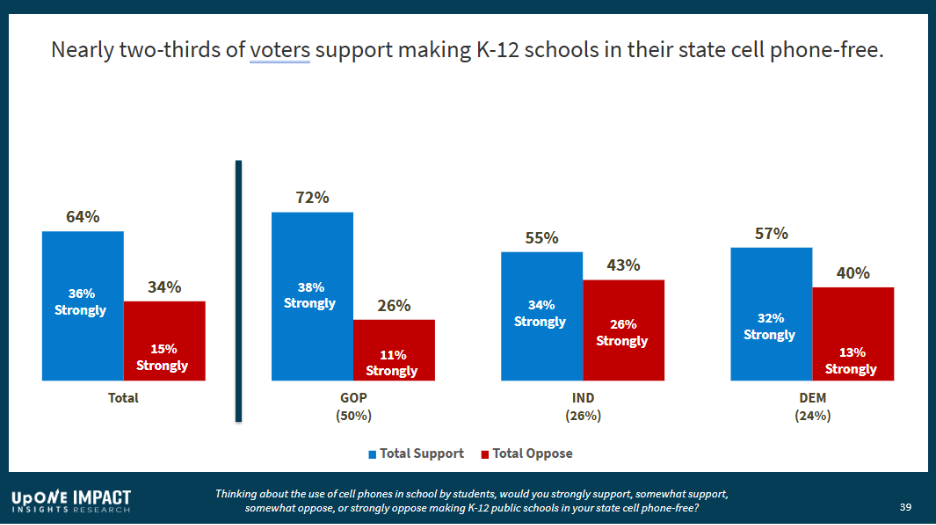
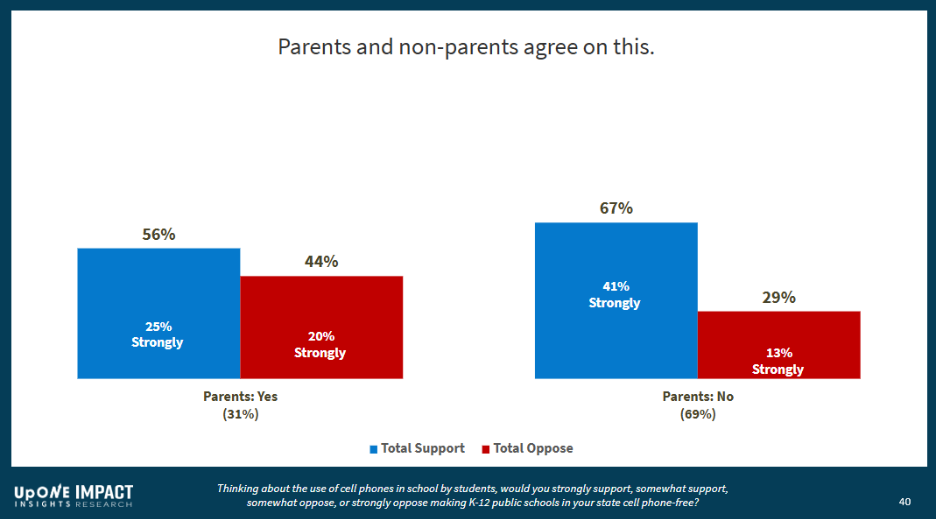
Both parents and non-parents express support for distraction-free schools, agreeing that removing cell phone use during the school day can help students stay focused and engaged in learning. The across-the-board support suggests that this is a priority across the broader community. Arkansas has already acted on this priority through the Bell to Bell, No Cell Act, a 2025 law now in effect this school year that requires all public districts and charter schools to adopt policies prohibiting student use of personal electronic devices during school hours. By creating consistent, statewide expectations, Arkansas is signaling that maintaining focused learning environments is essential to student success.
Taken together, the polling paints a consistent picture: Arkansans support education policies that are student-centered, results-oriented and grounded in high expectations. For policymakers, advocates and education leaders, Arkansas voters’ support lies in reforms that promote academic rigor accountability and opportunity for all students.
ExcelinEd also released a poll of registered voters in Arkansas earlier this year that dives deep into other issues. You can view those results here.
Connect with ExcelinEd’s policy team to learn more about the poll results and explore solutions tailored to Arkansas’ needs. Together, we can ensure student-centered policies continue to change lives.
