Devin Babcock is a Legislative Director for ExcelinEd in Action.


Student achievement in math is critical for all students, improving college and career options, prospects for future income and outcomes later in life. Demand for math-related occupations will grow nearly 29% by 2031. This demand isn’t being met by the math performance of students today. Nationally, fewer than 30% of 8th grade students achieve proficiency in math on the National Assessment for Educational Progress (NAEP). In Ohio, only 31% of 8th graders meet that mark.
Math Matters, a newly launched digital playbook from ExcelinEd, highlights 11 fundamental principles of math policy that, when adopted and implemented well, can lead to rising student achievement. Ohio currently has zero of the 11 policy benchmarks on the books, with only five of the principles partially adopted. As Ohio considers opportunities to strengthen statewide math policies, policymakers are likely to consider public sentiment in their decision-making process.
In light of that, ExcelinEd collaborated with UpOne Insights and Impact Partners to gain a better understanding of Ohioans’ views on key education issues, including mathematics.
The statewide survey of 600 registered Ohio voters, conducted online from Sept. 22 – Oct. 1, 2025 (±4.56%), demonstrates that Ohioans continue to ask for reforms to strengthen math achievement.
Below are some of the most important insights from the survey related to math and the policies Ohioans support.
Ohioans across the state and across party lines agree on the importance of improving education. Ensuring students reach grade-level proficiency in math, alongside reading and writing should be a top priority for lawmakers.
In fact, more than eight in 10 Ohioans (83%) say ensuring students reach grade-level proficiency in math, reading and writing is very important.
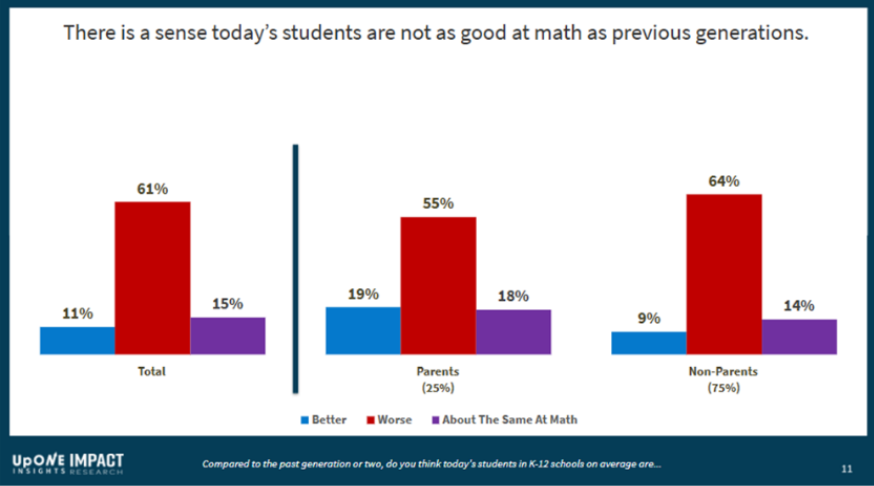
Concern about math achievement is clear: six in 10 Ohioans (61%) believe students today are worse at math than previous generations.
In response, voters overwhelmingly support strengthening math instruction early and consistently.
Voters strongly support policies that emphasize foundational math skills. Improving math scores starts with guaranteeing at least 60 minutes of daily math instruction. Regular, sustained practice builds the foundation students need to succeed, and this standard mirrors the approach of top-performing countries. When asked about a proposal to introduce 60 minutes of math each day for elementary students, survey respondents demonstrated an exceptionally high level of support (91%).

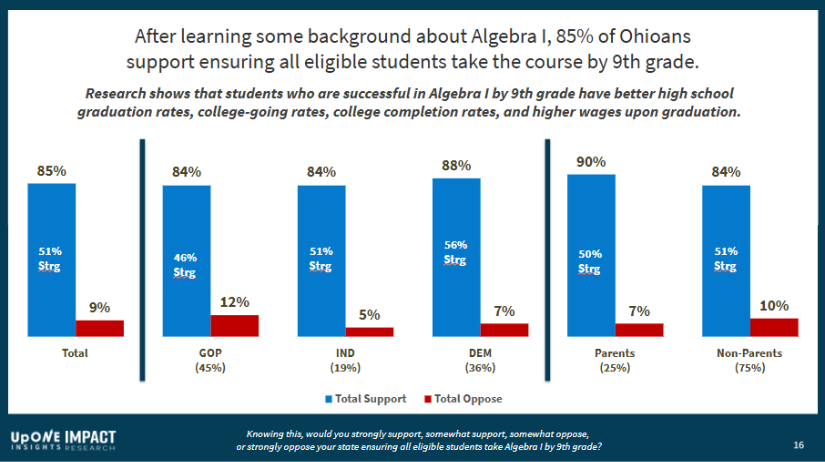
A substantial body of research links success in Algebra I to improved academic and career outcomes. As a result, ExcelinEd’s comprehensive math policy includes requiring all students to take and pass Algebra I or Integrated Math I by ninth grade, ensuring they are prepared for the academic rigor of high school and postsecondary opportunities. This policy also received exceptionally strong support among Ohioans, with 85% of respondents in agreement.
Ohioans also strongly supported guaranteed access to advanced math for high-performing students, at 83%. This proven math policy has been adopted in several states. It ensures that students who are mathematically ready are proactively identified and enrolled in advanced math pathways leading to Algebra I in middle school, positioning high performers to reach higher-level math courses in high school.

The level of agreement across these proposals suggests strong public backing for efforts to improve math outcomes statewide.
With high demand from Ohio voters for reforms to support math achievement, there are clear steps that policymakers can take to boost student success. Adopting strong legislation already under consideration—such as Ohio Senate Bill 19—is an essential first step. Senate Bill 19 also provides advanced math opportunities to high achieving individuals, allowing students to be placed in appropriately challenging math courses without barriers. Building on the foundation set by SB 19, lawmakers could go further by tackling areas of highest need: ensuring students who struggle with numeracy, as demonstrated by state assessments and screeners, receive timely, high-quality math supports.
Ohio can establish policy that involves parents directly in a student’s math achievement. Recommendations include requiring parental notification any time a student needs additional supports and providing families with a “math-at-home” plan to extend learning beyond the classroom. Together, these steps—paired with the interventions outlined in SB 19—would create a comprehensive, aligned approach to raising math achievement across the state.
Policymakers can build on these initial efforts with comprehensive, systemic changes that support long-term success. Aligning educator preparation programs and teacher professional development to the state math plan while placing math coaches in elementary schools will equip Ohio’s teachers with the tools they need. Requiring 60 minutes of math per day for elementary students will ensure young students establish a strong foundation in math and develop essential skills needed for long-term success.
Taken together, these policy solutions position Ohio to deliver on voters expectations and secure stronger math outcomes for every student.
