Laura Sheridan is an Associate Director of State Policy & Legislation for ExcelinEd in Action.

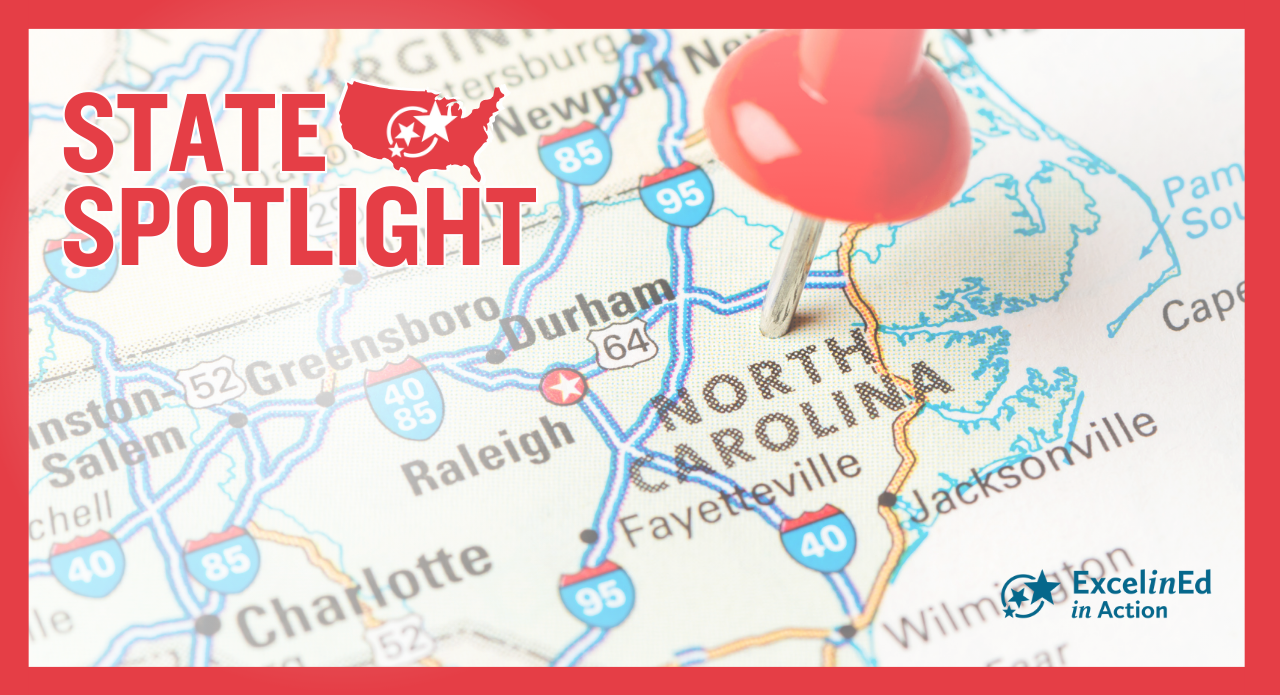
While North Carolina is one of the final states to approve a budget this year, it’s a great one for students.
The budget provides strategic investments in K-12 education, ranging from early literacy and supporting teachers to parental choice. This historic effort by the North Carolina legislature will improve students’ lives and academic outcomes for years to come.
Starting with the next school year, every North Carolina family will be eligible to apply for an Opportunity Scholarship to expand access to more learning options for their children. North Carolina joins a growing list of states this year—including Florida, Arkansas, Iowa, Indiana and Utah—offering universal or near-universal eligibility in their choice programs.
The funding amount provided through an Opportunity Scholarship will depend on family income, with households qualifying for free or reduced-price lunches receiving a full scholarship of about $7,400. Families with higher household income will be eligible for a portion of that amount.
Senate President Pro Tempore Phil Berger led the charge to empower North Carolina families with opportunity, saying the new budget “puts student outcomes and parental choice ahead of bureaucracy.”
For the immediate future and current school year, the legislature increased funding to give an additional 30,000 low-income families immediate access to the Opportunity Scholarship.
North Carolina partner, Parents for Educational Freedom in North Carolina, has worked tirelessly on behalf of all students and their families.
The group’s president, Mike Long, said the bipartisan budget “ensures our state takes the next step forward for parental school choice options while funding students over systems.”
Lawmakers wisely took a step forward in early literacy this year, banning the deeply flawed “three-cueing” method of instruction that emphasizes memorization and guessing over phonics, which provides a stronger, lasting base of learning for young students.
This move places North Carolina as one of the few states nationally that have adopted all 17 principles of ExcelinEd’s comprehensive early literacy policy.
State Superintendent of Public Instruction Catherine Truitt has maintained a strong focus on the importance of early literacy.
“Reading is foundational to a child’s academic and career success,” Truitt said last month. “So, when pre-pandemic data reflected how many of our students were entering high school unable to read proficiently, a new approach was needed.”
The state has been a leader in putting the proven science of reading at the center of early literacy policy. And as a result, the state has achieved literacy learning gains over the past two years for the state’s youngest students.
In an effort to attract and retain skilled teachers, many states invested in pay raises this year for educators.
North Carolina did that—and more.
All teachers will receive a raise, with newer teachers receiving a higher percentage. Beginning teacher pay will increase by $4,000—to $41,000—over the next two years.
The legislature took a creative path to rewarding highly effective teachers who provide support and training to newer educators. Teachers in the state’s initiative will receive supplements to their salary for providing professional support to beginning teachers. Lawmakers are investing $10.9 million in both years of the budget for the salary supplements. Teachers with certain certifications or licenses will also receive a salary supplement.
Finally, in this year’s budget, lawmakers maintained funding for a short-term workforce development grant program that provides $750 for students pursuing noncredit industry workforce credentials. The budget provides programs in a wide variety of industries with eligibility for the grant, including “programs such as architecture and construction, health sciences, information technology, electrical line worker, and manufacturing programs and may include other programs to meet local workforce needs.”
